Superfluid Staking
Abstract
Superfluid Staking provides the consensus layer more security with a sort of "Proof of Useful Stake". Each person gets an amount of Osmo representative of the value of their share of liquidity pool tokens staked and delegated to validators, resulting in the security guarantee of the consensus layer to also be based on GAMM LP shares. The OSMO token is minted and burned in the context of Superfluid Staking. Throughout all of this, OSMO's supply is preserved in queries to the bank module.
The process
All of the below methods are found under the Superfluid modules.
- The
SuperfluidDelegatemethod stores your share of bonded liquidity pool tokens, withvalidateLockas a verifier for lockup time. GetSuperfluidOsmomints OSMO tokens each day for delegation as a representative of the value of your pool share. This amount is minted because the staking module at the moment requires staked tokens to be in OSMO. This amount is burned each day and re-minted to keep the representative amount of the value of your pool share accurate. The lockup duration is guaranteed from the underlying lockup module.GetExpectedDelegationAmountiterates over each (denom, delegate) pair and checks for how much OSMO we have delegated. The difference from the current balance to what is expected is burned / minted to match with the expected.- A
messageServermethod executes the Superfluid delegate message. syntheticLockupis used to index bond holders and tracking their addresses for reward distribution or potentially slashing purposes. These track whether if your Superfluid stake is currently bonding or unbonding.- An
IntermediaryAccountis mostly used for the actual reward distribution or slashing events, and are responsible for establishing the connection between each superfluid staked lock and their delegation to the validator. These work by transferring the superfluid OSMO to their respective delegators. Rewards are linearly scaled based on how much you have locked for a given (validator, denom) pair. Rewards are first moved to the incentive gauges, then distributed from the gauges. In this way, we're using the existing gauge reward system for paying out superfluid staking rewards and tracking the amount you have superfluidly staked using the lockup module. - Rewards are distributed per epoch, which is currently a day.
abci.gochecks whether or not the current block is at the beginning of the epoch usingBeginBlock. - Superfluid staking will continue to expand to other Osmosis pools based on governance proposals and vote turnouts.
Example
If Alice has 500 GAMM tokens bonded to the ATOM <> OSMO, she will have the equivalent value of OSMO minted, delegated to her chosen staker, and burned for her each day with Superfluid staking. On the user side, all she has to know is who she wants to delegate her tokens to. In order to switch delegation, she has to unbond her tokens from the pool first and then redeposit. Bob, who has a share of the same liquidity pool before Superfluid Staking went live, also has to re-deposit into the pool for the above process to kickstart.
Why mint Osmo? How is this method safe and accurate?
Superfluid staking requires the minting of OSMO because in order to stake on the Osmosis chain, OSMO tokens are required as the chosen collateral. Synthetic Osmo is minted here as a representative of the value of each superfluid staker's liquidity pool tokens.
The pool tokens are acquired by the user from normally staking in a liquidity pool. They get minted an amount of OSMO equivalent to the value of their GAMM pool tokens. This method is accurate because querying the value OSMO every day allows for burning and minting according to the difference in value of OSMO relative to the expected delegation amount (as seen with GetExpectedDelegationAmount). It's like having a price oracle for fairly calculating the amount the user has superfluidly staked.
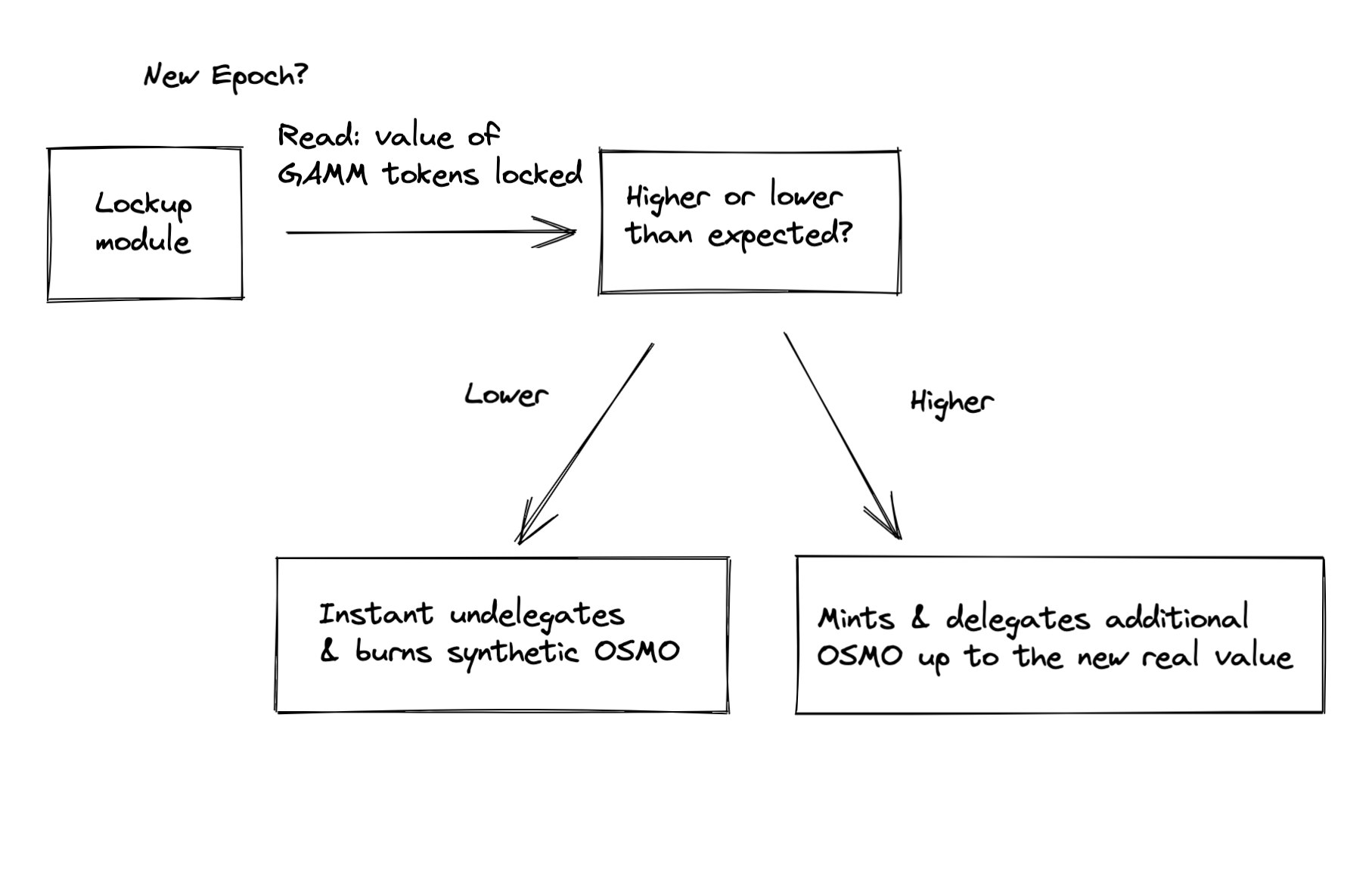
On epoch (start of every day), we read from the lockup module how much
GAMM tokens we have locked which acts as an oracle for the
representative price of the GAMM token shares. The superfluid module has
"hooks" messages to refresh delegation amounts
(RefreshIntermediaryDelegationAmounts) and to increase delegation on
lockup (IncreaseSuperfluidDelegation). Then, we see whether or not the
superfluid OSMO currently delegated is worth more or less than this
expected delegation amount. If the OSMO is worth more, we do
instant undelegations and immediately burn the OSMO. If less, we mint
OSMO and update the amount delegated. A simplified diagram of this whole
process is found below:
This minting is safe because we strict constrain the permissions of Bank
(the module that burns and mints OSMO) to do what it's designed to do.
The authority is mediated through mintOsmoTokensAndDelegate and
forceUndelegateAndBurnOsmoTokens keeper methods called by the
SuperfluidDelegate and SuperfluidUndelegate message handlers for the
tokens. The hooks above that increase delegation and refresh delegation
amounts also call this keeper method.
The delegation is then verified to not already be associated with an intermediary account (to prevent double-staking), and is always delegated or withdrawn taking into account various multipliers for synthetic OSMO value (its worth with respect to the liquidity pool, and a risk modifier) to prevent mint inaccuracies. Before minting, we also check that the message sender is the owner of the locked funds; that the lock is not unlocking; is locked for at least the unbonding period, and is bonded to a single asset. We also check to see if the lock isn't already in superfluid and that the same lock isn't currently being unbonded.
On the end of each epoch, we iterate through all intermediary accounts to withdraw delegation rewards they may have received and put it all into the perpetual gauges corresponding to each account for reward delegation.
Bonding, unbonding, slashing
Here, we describe how token bonding and unbonding works, and what happens to your superfluid tokens in the case of a slashing event.
Bonding
When bonding, your input tokens are locked up and you are given GAMM pool tokens in exchange. These GAMM pool tokens represent a share of the total liquidity pool, and allows you to get transaction fees or participate in external incentive gauge token distributions. When bonding, on top of the regular bonding transaction there will also be a selection of validators. As stated above, OSMO is also minted and burned each day and superfluidly staked to whoever you have chosen to be your validator. You gain additional APR as a reward for bolstering the Osmosis chain's consensus integrity by delegating.
Unbonding
When unbonding, superfluid tokens get un-delegated. After making sure that the unbond message sender is the owner of their corresponding locked funds, the existing synthetic lockup is deleted and replaced with a new synthetic lockup for unbonding purposes. The undelegated OSMO is then instantly withdrawn from the intermediate account and validator using the InstantUndelegate function. The OSMO that was originally used for representing your LP shares are burnt. Moves the tracker for unbonding, allows the underlying lock to start unlocking if desired
Concepts
SyntheticLockups
SyntheticLockups are synthetic forms of PeriodLocks, but different in the sense that they store suffix, which is a combination of bonding/unbonding status + validator address. This is mainly used to track whether an individual lock that has been superfluid staked has an bonding status or an unbonding status from the staking delegations.
Intermediary Account
Intermediary Accounts establish the connections between the superfluid staked locks and delegations to the validator. Intermediary accounts exist for every denom + validator combination, so that it would group locks with the same denom + validator selection. Superfluid staking a lock would mint equivalent amount of OSMO of the lock and send it to the intermediary account and the intermediary accounts would be delegating to the specified validator.
Intermediary Account Connection
Intermediary Accounts Connection serves the role of tracking the locks that an Intermediary Account is dedicated to.
State
Superfluid Asset
A superfluid asset is an alternative asset (non-OSMO) that is allowed by governance to be used for staking.
It can only be updated by governance proposals. We validate at proposal creation time that the denom + pool exists. (Are we going to ignore edge cases around a reference pool getting deleted it)
Intermediary Accounts
Lots of questions to be answered here
Dedicated Gauges
Each intermediary account has a dedicated gauge where it sends the delegation rewards to. Gauges are distributing the rewards to end users at the end of the epoch.
Synthetic Lockups created
At the moment, one lock can only be fully bonded to one validator.
Osmo Equivalent Multipliers
The Osmo Equivalent Multiplier for an asset is the multiplier it has for its value relative to OSMO.
Different types of assets can have different functions for calculating their multiplier. We currently support two asset types.
- Native Token
The multiplier for OSMO is always 1.
- Gamm LP Shares
Currently we use the spot price for an asset based on a designated osmo-basepair pool of an asset. The multiplier is set once per epoch, at the beginning of the epoch. In the future, we will switch this out to use a TWAP instead.
State changes
The state of superfluid module state modifiers are classified into below categories.
Messages
Superfluid Delegate
Owners of superfluid asset locks can submit MsgSuperfluidDelegate
transactions to delegate the Osmo in their locks to a selected
validator.
type MsgSuperfluidDelegate struct {
 Sender  string
 LockId  uint64
 ValAddr string
}
State Modifications:
- Safety Checks that are being done before running superfluid logic:
- Check that
Senderis the owner oflock - Check that
lockcorresponds to a single locked asset - Check that
lockis not unlocking - Check that
lockis locked for at least the unbonding period - Check that this
LockIDis not already superfluided - Check that the same lock isn't being unbonded
- Check that
- Get the
IntermediaryAccountfor this lock'sDenomandValAddrpair.- Create it + a new gauge for the synthetic denom, if it does not yet exist.
- Create a SyntheticLockup.
- Calculate
Osmoto delegate on behalf of thislock, asOsmo Equivalent Multiplier*# LP Shares*Risk Adjustment Factor- If this amount is less than 0.000001
Osmo(1 uosmo) reject the transaction, as it would be delegating0 uosmo
- If this amount is less than 0.000001
- Mint
Osmoto match this amount and send toIntermediaryAccount - Create a delegation from
IntermediaryAccounttoValidator - Create a new perpetual
Gaugefor distributing staking payouts to locks of a synethic asset based on thisValidator/Denompair. - Create a connection between this
lockIDand thisIntermediaryAccount
Superfluid Undelegate
type MsgSuperfluidUndelegate struct {
 Sender string
 LockId uint64
}
State Modifications:
- Lookup
lockbyLockID - Check that
Senderis the owner oflock - Get the
IntermediaryAccountfor thislockID - Delete the
SyntheticLockupassociated to thislockID+ValAddrpair - Create a new
SyntheticLockupwhich is unbonding - Calculate the amount of
Osmodelegated on behalf of thislockasOsmo Equivalent Multiplier*# LP Shares*Risk Adjustment Factor- If this amount is less than 0.000001
Osmo, there is no delegatedOsmoto undelegate and burn
- If this amount is less than 0.000001
- Use
InstantUndelegateto instantly remove delegation fromIntermediaryAccounttoValidator - Immediately burn undelegated
Osmo - Delete the connection between
lockIDandIntermediaryAccount
Lock and Superfluid Delegate
type MsgLockAndSuperfluidDelegate struct {
 Sender string
 Coins sdk.Coins
 ValAddr string
}
This is effectively a multimsg tx of lockup's MsgLockTokens and
superfluid's MsgSuperfluidDelegate, but it is implemented as a single
msg, because currently we don't have a way of passing the lockid
outputted by MsgLockTokens as an input into the
MsgSuperfluidDelegate prior to execution.
State Modifications:
- Ensures that Coins has a length of only 1 (we use sdk.Coins instead of sdk.Coin in order to allow more flexibility in the future)
- Creates a lockup with Coins of a lock duration equivalent to the
unstaking period from the staking module
- Uses the lockup module's MsgServer
- Gets the lock id of the created lock, and uses it generate and
execute a MsgSuperfluidDelegate message
- Uses the SuperfluidDelegate function on this msg server
Superfluid Unbond Lock
type MsgSuperfluidUnbondLock struct {
 Sender string
 LockId uint64
}
This message does all the functionality of MsgSuperfluidUndelegate but
also starts unbonding the underlying lock as well, allowing both the
unstaking and unlocking to complete at the same time. Without using this
function, a user will not be able to start unbonding their underlying
lock until after the unstaking has finished.
State Modifications:
- This runs the functionality of
MsgSuperfluidUndelegate - It then triggers a force unbond of the underlying lock id
Epochs
Overall Epoch sequence
- Epoch N ends, during AfterEpochEnd:
- Distribute gauge rewards for all non-superfluid gauges
- Mint new tokens
- Issue new Osmo, and send to various modules (distribution, incentives, etc.)
- 25% currently goes to
x/distributionwhich fundsStakingandSuperfluidrewards - Rewards for
Superfluidare based on the just updated delegation amounts, and queued for payout in the next epoch
- BeginBlock for Distribution
- Distribute staking rewards to all of the 'lazy accounting' accumulators. (F1)
- Epoch N ends, during BeginBlock for superfluid After
AfterEpochEnd:
- Claim staking rewards for every
Intermediary Account, put them into gauges. - Distribute Superfluid staking rewards from gauges to bonded Synthetic Lock owners
- Update
Osmo Equivalent Multipliervalue for each LP token- (Currently spot price at epoch)
- Refresh delegation amounts for all
Intermediary Accounts- Calculate the expected delegation for this account as
Osmo Equivalent Multiplier# LP SharesRisk adjustment- If this is less than 0.000001
Osmoit will be rounded to 0
- If this is less than 0.000001
- Lookup current delegation amount for
Intermediary Account- If there is no delegation, treat the current delegation as 0
- If expected amount > current delegation:
- Mint new
OsmoandDelegatetoValidator
- Mint new
- If expected amount < current delegation:
- Use
InstantUndelegateand burn the receivedOsmo
- Use
- Calculate the expected delegation for this account as
- Claim staking rewards for every
Staking power updates
We need to be concerned with how/when validators enter and leave the active set.
We expect the guarantee that there is an Intermediary account for every (active validator, superfluid denom) pair, and every (unbonding validator, superfluid denom) pair. (TODO: Where/why)
We also want to avoid resource exhaustion attacks. We relegate concerns around upper-bounding the number of active + unbonding validators to the staking module. This module is liable to potentially cause a 100-1000x amplification factor on this workload.
How we handle it now
- Intermediary accounts are not created on SetSuperfluidAsset
- They are created at-time-of-need on MsgSuperfluidDelegate
- Concerns: What happens if you delegate to an unbonding or jailed validator. Note: Isn't it same as normal delegation for unbonding validator?
Other Module Hooks
-----;
In this section we describe the "hooks" that superfluid module
receives from other modules.
AfterEpochEnd
On AfterEpochEnd, we iterate through all existing intermediary accounts and withdraw delegation rewards they have received. Then we send the collective rewards to the perpetual gauge corresponding to the intermediary account. Then we update OSMO backing per share for the specific pool. After the update, iteration through all intermediate accounts happen, undelegating and bonding existing delegations for all superfluid staking and use the updated spot price at epoch time to mint and delegate.
AfterAddTokensToLock
When a token is locked, we first check if the corresponding lock is currently in the state of superfluid delegation. If it is, we run the logic to add delegation via intermediary account.
BeforeValidatorSlashed
Slashes the synthetic lockups and native lockups that is connected to the to be slashed validator.
Proposal Hooks
-----;
In this section we describe the proposals that is associated to superfluid module.
SetSuperfluidAssetsProposal
Enable multiple superfluid assets to be used for superfluid staking.
RemoveSuperfluidAssetsProposal
Disable multiple assets from being used for superfluid staking.
Events
There are 7 types of events that exist in Superfluid module:
types.TypeEvtSetSuperfluidAsset- "set_superfluid_asset"types.TypeEvtRemoveSuperfluidAsset- "remove_superfluid_asset"types.TypeEvtSuperfluidDelegate- "superfluid_delegate"types.TypeEvtSuperfluidIncreaseDelegation- "superfluid_increase_delegation"types.TypeEvtSuperfluidUndelegate- "superfluid_undelegate"types.TypeEvtSuperfluidUnbondLock- "superfluid_unbond_lock"types.TypeEvtUnpoolId- "unpool_pool_id"
types.TypeEvtSetSuperfluidAsset
This event is emitted in the proposal which set new superfluid asset
It consists of the following attributes:
types.AttributeDenom- The value is the asset denom.
types.AttributeSuperfluidAssetType- The value is the type of asset.
types.TypeEvtRemoveSuperfluidAsset
This event is emitted in the proposal which removes the superfluid asset
It consists of the following attributes:
types.AttributeDenom- The value is the asset denom.
types.TypeEvtSuperfluidDelegate
This event is emitted in the message server after successfully creating a delegation for the given lock ID and the validator to delegate to.
It consists of the following attributes:
types.AttributeLockId- The value is the given lock ID.
types.AttributeValidator- The value is the validator address to delegate to.
types.TypeEvtSuperfluidIncreaseDelegation
This event is emitted in the hook after adding more token to the existing lock
It consists of the following attributes:
types.AttributeLockId- The value is the given lock ID.
types.AttributeAmount- The value is the token amount added to the lock.
types.TypeEvtSuperfluidUndelegate
This event is emitted in the message server after undelegating the currently superfluid delegated position given by lock ID.
It consists of the following attributes:
types.AttributeLockId- The value is the given lock ID.
types.TypeEvtSuperfluidUnbondLock
This event is emitted in the message server after starting unbonding for the currently superfluid undelegating lock.
It consists of the following attributes:
types.AttributeLockId- The value is the given lock ID.
types.TypeEvtUnpoolId
This event is emitted in the message server UnPoolWhitelistedPool
It consists of the following attributes:
types.AttributeKeySender- The value is the msg sender address.
types.AttributeLockId- The value is the pool lpShareDenom.
types.AttributeNewLockIds- The value is the exited lock ids in byte[].
Messages
MsgSuperfluidDelegate
| Type | Attribute Key | Attribute Value |
|---|---|---|
| superfluid_delegate | lock_id | {lock_id} |
| superfluid_delegate | validator | {validator} |
MsgSuperfluidUndelegate
| Type | Attribute Key | Attribute Value |
|---|---|---|
| superfluid_undelegate | lock_id | {lock_id} |
MsgSuperfluidUnbondLock
| Type | Attribute Key | Attribute Value |
|---|---|---|
| superfluid_unbond_lock | lock_id | {lock_id} |
MsgLockAndSuperfluidDelegate
| Type | Attribute Key | Attribute Value |
|---|---|---|
| lock_tokens | period_lock_id | {periodLockID} |
| lock_tokens | owner | {owner} |
| lock_tokens | amount | {amount} |
| lock_tokens | duration | {duration} |
| lock_tokens | unlock_time | {unlockTime} |
| message | action | lock_tokens |
| message | sender | {owner} |
| transfer | recipient | {moduleAccount} |
| transfer | sender | {owner} |
| transfer | amount | {amount} |
| superfluid_delegate | lock_id | {lock_id} |
| superfluid_delegate | validator | {validator} |
Proposals
SetSuperfluidAssetsProposal
| Type | Attribute Key | Attribute Value |
|---|---|---|
| set_superfluid_asset | denom | {denom} |
| set_superfluid_asset | superfluid_asset_type | {asset_type} |
RemoveSuperfluidAssetsProposal
| Type | Attribute Key | Attribute Value |
|---|---|---|
| remove_superfluid_asset | denom | {denom} |
Queries
Params
message ParamsRequest {};

message ParamsResponse {
  // params defines the parameters of the module.
  Params params = 1 [ (gogoproto.nullable) = false ];
}

message Params {
  sdk.Dec minimum_risk_factor = 1; // serialized as string
}
The params query returns the params for the superfluid module. This currently contains:
MinimumRiskFactorwhich is an sdk.Dec that represents the discount to apply to all superfluid staked modules when calculating their staking power. For example, if a specific denom has an OSMO equivalent value of 100 OSMO, but theMinimumRiskFactorparam is 0.05, then the denom will only get 95 OSMO worth of staking power when staked.
AssetType
message AssetTypeRequest {
    string denom = 1;
};

message AssetTypeResponse {
    SuperfluidAssetType asset_type = 1;
};

enum SuperfluidAssetType {
  SuperfluidAssetTypeNative = 0;
  SuperfluidAssetTypeLPShare = 1;
}
The AssetType query returns what type of superfluid asset a denom is. AssetTypes are meant for when we support more types of assets for superfluid staking than just LP shares. Each AssetType has a different algorithm used to get its "Osmo equivalent value".
We represent different types of superfluid assets as different enums.
Currently, only enum 1 is actually used. Enum value 0 is reserved
for the Native staking token for if we deprecate the legacy staking
workflow to have native staking also go through the superfluid module.
In the future, more enums will be added.
If this query errors, that means that a denom is not allowed to be used for superfluid staking.
AllAssets
message AllAssetsRequest {};

message AllAssetsResponse {
  repeated SuperfluidAsset assets = 1 [ (gogoproto.nullable) = false ];
};

message SuperfluidAsset {
  string denom = 1;
  SuperfluidAssetType asset_type = 2;
}
This parameterless query returns a list of all the superfluid staking
compatible assets. The return value includes a list of SuperfluidAssets,
which are pairs of denom with SuperfluidAssetType which was
described in the previous section.
This query does not currently support pagination, but may in the future.
AssetMultiplier
message AssetMultiplierRequest {
    string denom = 1;
};

message AssetMultiplierResponse {
  OsmoEquivalentMultiplierRecord osmo_equivalent_multiplier = 1;
};

message OsmoEquivalentMultiplierRecord {
  int64 epoch_number = 1;
  string denom = 2;
  string multiplier = 3;
}
This query allows you to find the multiplier factor on a specific denom. The Osmo-Equivalent-Multiplier Record for epoch N refers to the osmo worth we treat a denom as having, for all of epoch N. For now, this is the spot price at the last epoch boundary, and this is reset every epoch. We currently don't store historical multipliers, so the epoch parameter is kind of meaningless for now.
To calculate the staking power of the denom, one needs to multiply the
amount of the denom with OsmoEquivalentMultipler from this query with
the MinimumRiskFactor from the Params query endpoint.
staking_power = amount * OsmoEquivalentMultipler * MinimumRiskFactor
ConnectedIntermediaryAccount
message ConnectedIntermediaryAccountRequest {
  uint64 lock_id = 1;
}

message ConnectedIntermediaryAccountResponse {
  SuperfluidIntermediaryAccountInfo account = 1;
}

message SuperfluidIntermediaryAccount {
  string denom = 1;
  string val_addr = 2;
  uint64 gauge_id = 3; // perpetual gauge for rewards distribution
}
Every superfluid denom and validator pair has an associated "intermediary account", which does the actual delegation. This query helps find the superfluid intermediary account for any superfluid position.
That lock_id parameter passed in is the underlying lock id for the
superfluid, NOT the synthetic lock id.
This query can be used to find the validator a superfluid lock is
delegated to. The gauge_id also refers to the perpetual gauge that is
used to pay out the superfluid positions associated with this
intermediary account.
AllIntermediaryAccounts
message AllIntermediaryAccountsRequest {
  cosmos.base.query.v1beta1.PageRequest pagination = 1;
};

message AllIntermediaryAccountsResponse {
  repeated SuperfluidIntermediaryAccountInfo accounts = 1;
  cosmos.base.query.v1beta1.PageResponse pagination = 2;
};
This query returns a list of all superfluid intermediary accounts. It supports pagination.
SuperfluidDelegationAmount
message SuperfluidDelegationAmountRequest {
  string delegator_address = 1;
  string validator_address = 2;
  string denom = 3;
}

message SuperfluidDelegationAmountResponse {
  repeated cosmos.base.v1beta1.Coin amount = 1 [];
}
This query returns the amount of underlying denom (i.e. lp share) for a triplet of delegator, validator, and denom.
SuperfluidDelegationsByDelegator
message SuperfluidDelegationsByDelegatorRequest {
  string delegator_address = 1;
}

message SuperfluidDelegationsByDelegatorResponse {
  repeated SuperfluidDelegationRecord superfluid_delegation_records = 1;
  repeated cosmos.base.v1beta1.Coin total_delegated_coins = 2;
}

message SuperfluidDelegationRecord {
  string delegator_address = 1;
  string validator_address = 2;
  cosmos.base.v1beta1.Coin delegation_amount = 3;
}
This query returns a list of all the superfluid delegations of a specific delegator. The return value includes, the validator delegated to and the delegated coins (both denom and amount).
The return value of the query also includes the total_delegated_coins
which is the sum of all the delegations of that validator.
This query does require iteration that is linear with the number of delegations a delegator has made, but for now until we support many superfluid denoms, should be relatively bounded. Once that increases, we will need to support pagination.
SuperfluidDelegationsByValidatorDenom
message SuperfluidDelegationsByValidatorDenomRequest {
  string validator_address = 1;
  string denom = 2;
}

message SuperfluidDelegationsByValidatorDenomResponse {
  repeated SuperfluidDelegationRecord superfluid_delegation_records = 1;
}
This query returns a list of all superfluid delegations that are with a validator / superfluid denom pair. This query requires a lot of iteration and should be used sparingly. We will need to add pagination to make this usable.
EstimateSuperfluidDelegatedAmountByValidatorDenom
message EstimateSuperfluidDelegatedAmountByValidatorDenomRequest {
  string validator_address = 1;
  string denom = 2;
}

message EstimateSuperfluidDelegatedAmountByValidatorDenomResponse {
  repeated cosmos.base.v1beta1.Coin total_delegated_coins = 1;
}
This query returns the total amount of delegated coins for a validator /
superfluid denom pair. This query does NOT involve iteration, so should
be used instead of the above SuperfluidDelegationsByValidatorDenom
whenever possible. It is called an "Estimate" because it can have some
slight rounding errors, due to conversions between sdk.Dec and
sdk.Int", but for the most part it should be very close to the sum of
the results of the previous query.
Parameters
The superfluid module contains the following parameters:
| Key | Type | Example |
|---|---|---|
| minimum_risk_factor | decimal | 0.01 |
Slashing
Slashing works by gathering all accounts who were superfluidly staking and delegated to the violating validator and slashing their underlying lock collateral. The amount of tokens to slash are first calculated then removed from the underlying and synthetic lock. Therefore, it is important to select a reputable or reliable validator as to minimize slashing risks on your tokens. At the moment we are slashing at latest price rather than block height price. All slashed tokens go to the community pool.
We first get a hook from the staking module, marking that a validator is
about to be slashed at a slashFactor of f, for an infraction at height
h.
The staking module handles slashing every delegation to that validator, which will handle slashing the delegation from every intermediary account. However, it is up to the superfluid module to then:
- Slash every constituent superfluid staking position for this validator.
- Slash every unbonding superfluid staking position to this validator.
We do this by:
- Collect all intermediate accounts to this validator
- For each IA, iterate over every lock to the underlying native denom.
- If the lock has a synthetic lockup, it gets slashed.
- The slash works by calculating the amount of tokens to slash.
- It removes these from the underlying lock and the synthetic lock.
- These coins are moved to the community pool.
Nuances
- Slashed tokens go to the community pool, rather than being burned as in staking.
- We slash every unbonding, rather than just unbondings that started after the infraction height.
- We can "overslash" relative to the staking module. (For a slash factor of 5%, the staking module can often burn <5% of active delegation, but superfluid will always slash 5%)
We slash every unbonding, purely because lockup module tracks things by unbonding start time, whereas staking/slashing tracks things by height we begin unbonding at. Thus we get a problem that we cannot convert between these cleanly. Really there should be a storage of all historical block height <> block times for everything in the unbonding period, but this is not considered a near-term problem.
Correcting overslashing
The overslashing possibility stems from a problem in the SDKs slashing module, that really is a bug there, and superfluid is doing the correct thing. https://github.com/cosmos/cosmos-sdk/issues/1440
Basically, slashes to unbondings and redelegations can lower the amount that gets slashed from live delegations in the staking module today.
It turns out this edge case, where superfluid's intermediate account can have more delegation than expected from its underlying collateral, is already safely handled by the Superfluid refreshing logic.
The refreshing logic checks the total amount of tokens in locks to this denom (Reading from the lockup accumulation store), calculates how many osmo that's worth at the epochs new osmo worth for that asset, and then uses that. Thus this safely handles this edge case, as it uses the new 'live' lockup amount.
Minting
Superfluid module has the ability to arbitrarily mint and burn Osmo
through the bank module. This is potentially dangerous so we strictly
constrain it's ability to do so. This authority is mediated through the
mintOsmoTokensAndDelegate and forceUndelegateAndBurnOsmoTokens
keeper methods, which are in turn called by message handlers
(SuperfluidDelegate and SuperfluidUndelegate) as well as by hooks on
Epoch (RefreshIntermediaryDelegationAmounts) and Lockup
(IncreaseSuperfluidDelegation)
Invariant
Each of these mechanisms maintains a local invariant between the amount
of Osmo minted and delegated by the IntermediaryAccount, and the
quantity of the underlying asset held by locks associated to the
account, modified by OsmoEquivalentMultiplier and RiskAdjustment for
the underlying asset. Namely that total minted/delegated =
GetTotalSyntheticAssetsLocked * GetOsmoEquivalentMultiplier *
GetRiskAdjustment
This can be equivalently expressed as GetExpectedDelegationAmount
being equal to the actual delegation amount.
Message Handlers
SuperfluidDelegate
In a SuperfluidDelegate transaction, we first verify that this lock is
not already associated to an IntermediaryAccount, and then use
mintOsmoTokenAndDelegate to properly balance the resulting change in
GetExpectedDelegationAmount from the increase in
GetTotalSyntheticAssetsLocked. i.e. we mint and delegate:
GetOsmoEquivalentMultiplier * GetRiskAdjustment *
lock.Coins.Amount new Osmo tokens.
SuperfluidUndelegate
When a user submits a transaction to unlock their asset the invariant is
maintained by using forceUndelegateAndBurnOsmoTokens to remove an
amount of Osmo equal to lockedCoin.Amount *
GetOsmoEquivalentMultiplier * GetRiskAdjustment.
Superfluid Hooks
RefreshIntermediaryDelegationAmounts (AfterEpochEnd Hook)
In the RefreshIntermediaryDelegationAmounts method, calls are made to
mintOsmoTokensAndDelegate or forceUndelegateAndBurnOsmoTokens to
adjust the real delegation up or down to match
GetExpectedDelegationAmount.
IncreaseSuperfluidDelegation (AfterAddTokensToLock Hook)
This is called as a result of a user adding more assets to a lock that
has already been associated to an IntermediaryAccount. The invariant
is maintained by using mintOsmoTokenAndDelegate to match the amount of
new asset locked * GetOsmoEquivalentMultiplier * GetRiskAdjustment
for the underlying asset.
SlashLockupsForValidatorSlash (BeforeValidatorSlashed Hook)
During slashing the invariant is likely to be temporarily broken if the
referenced validator has any unbonding delegations. These unbonding
delegations are slashed first, which means that the amount delegated by
the IntermediaryAccount will be slashed by less than the
SyntheticLocks held by the account.
See Also
GetTotalSyntheticAssetsLocked
TODO - expand on this Uses lockup accumulator to find total amount of
synthetic locks for a given IntermediaryAccount (Superfluid Asset +
Validator pair)